
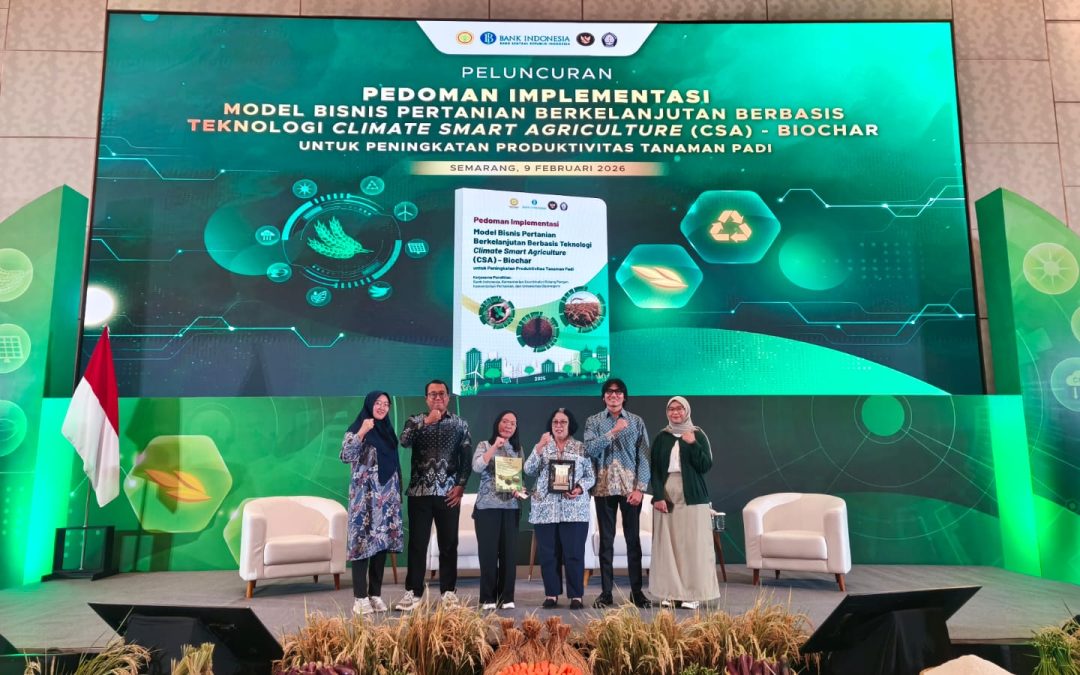
SEMARANG, February 2026 – Bank Indonesia has officially launched the “Implementation Manual for Sustainable Agriculture Business Models Based on CSA-Biochar Technology” as a strategic move to strengthen national food security through environmentally friendly practices. This manual is the culmination of an intensive research process and field assistance conducted by the Research Team from the Agroecotechnology Study Program, Faculty of Animal and Agricultural Sciences (FPP), Universitas Diponegoro (UNDIP).
The manual was comprehensively developed by a team of Agroecotechnology experts led by Prof. Dr. Ir. Florentina Kusmiyati, M.Sc., alongside Albertus Fajar Irawan, S.P., M.Agr., Ph.D., Muhammad Iqbal Fauzan, S.P., M.Si., Anasrullah, S.P., M.S., Septrial Arafat, S.P., M.P., and Nani Kitti Sihaloho, M.P. In this collaboration, the Agroecotechnology UNDIP team served as the dedicated research and authoring body, transforming scientific data into a practical reference for stakeholders.
The innovation studied by the researchers focuses on Climate Smart Agriculture (CSA) technology through the utilization of biochar. As academics, the Agroecotechnology FPP UNDIP team positions itself as a science-based solution provider (researchers), ensuring that every recommendation in this book empowers farmers to manage waste independently and sustainably, rather than acting as a commercial producer of biochar materials.
Through this launch by Bank Indonesia, the research findings of the Agroecotechnology UNDIP team contribute significantly to the achievement of the Sustainable Development Goals (SDGs), including:
-
SDG 2 (Zero Hunger): Supporting food stability through increased rice productivity that has been scientifically validated in piloting research.
-
SDG 12 (Responsible Consumption and Production): Promoting circular agriculture business models where farmers can efficiently manage local resources and minimize waste.
-
SDG 13 (Climate Action): Providing a scientific foundation for agricultural practices that significantly reduce methane gas emissions and enhance soil resilience against extreme weather changes.
This synergy emphasizes that the role of higher education as a research institution has a broad impact when its scientific output is adopted by authorities like Bank Indonesia for the public good. With the presence of this manual, Agroecotechnology FPP UNDIP reaffirms its commitment to remain a trusted partner in providing the data and innovation necessary for an inclusive and sustainable Indonesian agricultural sector.
Recent Comments